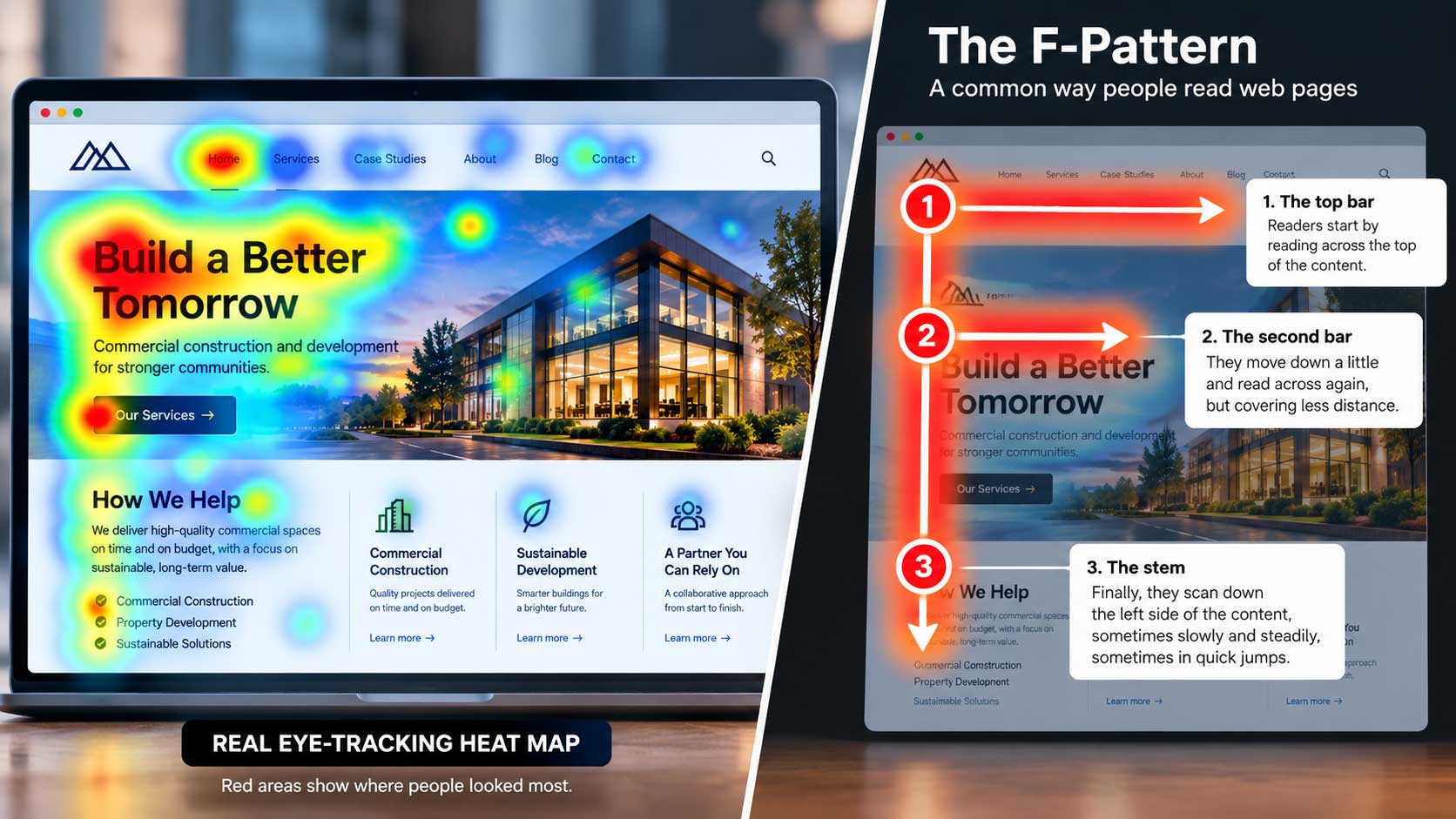
In 2006, the Nielsen Norman Group recorded the eye movements of 232 people as they looked at thousands of web pages. When the researchers combined the results into heat maps, a clear shape appeared. If you squint at those maps, you can almost make out the letter F.
How the F forms. The pattern happens in three stages:
- The top bar. Readers start by reading across the upper part of the content, in a horizontal line.
- The shorter second bar. They move down a little and read across again, but this time covering less distance.
- The stem. Finally, they scan down the left side of the content in a vertical line, sometimes slowly and steadily, sometimes in quick jumps.
When I compared heat maps from my own websites with Nielsen’s, I wasn’t surprised to see almost exactly the same pattern.
What it tells us. People don’t read web pages word by word. They scan. Headlines get read first, then subheadings, then the first few words of each paragraph and the start of each line on the left. Unless your content is a perfect match for what someone came to find, the first lines may be all they read before moving on. So make them count.
An important update. In later research, Nielsen Norman Group clarified that the F-pattern isn’t a goal to design for. It’s what happens when a page gives readers nothing better to follow, such as a wall of text with no clear structure. Readers also use other patterns, like skimming headings and subheadings in what researchers call a “layer-cake” pattern, or jumping to specific words such as prices and names.
The practical lesson is the same either way: structure your content so scanning works.
How to write for scanners:
- Put the most important information in your headline and first sentence.
- Use clear, descriptive subheadings so people can skim to what they need.
- Start paragraphs and list items with their key words.
- Keep paragraphs short, and use bullet points for lists of items.
- Place your most important links and buttons where the eye naturally travels, near the top and along the left.
When you understand how people read, you start designing pages and writing text differently. You stop hoping visitors will read everything and start making sure they find what matters.