
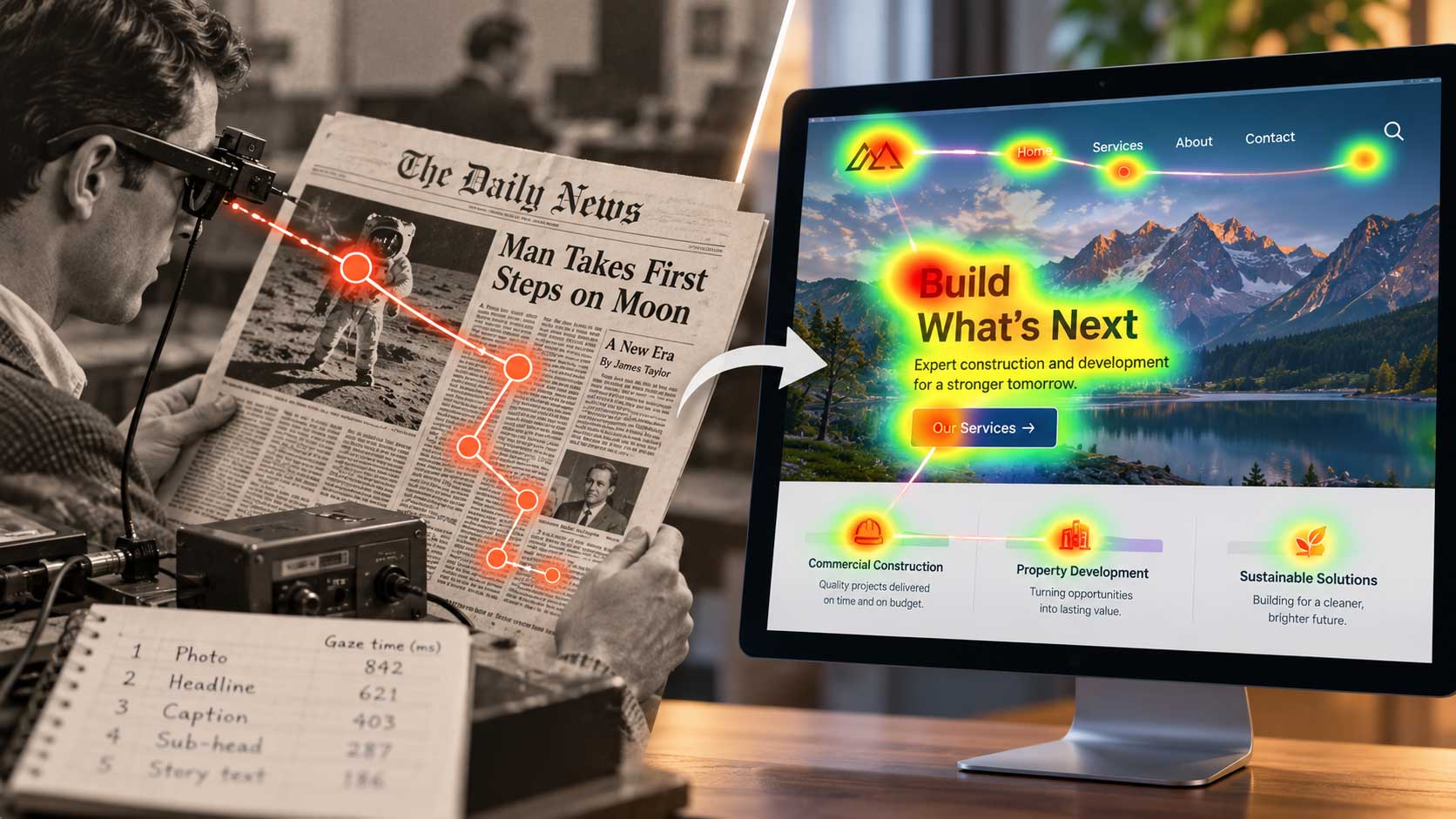
How do you make the top of your homepage stand out the right way, and lead visitors to find out more? The blocks of information you need aren’t complicated. The real challenge is arranging them so the page flows naturally for the eye.
With modern website tools, the design possibilities are practically endless. But there are rules, if you want people to read and respond to your website the way you hope. Some of the most useful of those rules come from a surprising place: newspaper research.
Cameras on glasses. The Poynter Institute, a journalism school and research organization in Florida, was a pioneer in studying how people actually read. Its researchers used special eye-tracking equipment, at first little more than tiny cameras mounted on glasses, to record where readers looked, in what order, and for how long. The tests used ordinary newspapers, and the subjects were regular readers looking at the publications they already knew.
The cameras may have been simple, but the analysis wasn’t. In later studies, run in partnership with the University of Florida, coders spent weeks assigning numerical codes to every recorded point of gaze, so the data would be scientifically reliable.
The surprising results. Poynter’s research on printed newspapers revealed that most people entered a page through its dominant photo. From there, their eyes moved to headlines, then captions and other secondary elements, and only then to the story itself. In general, the body text was the last stop on the reader’s journey.
That came as a surprise to many editors, who had assumed readers started with the lead story. The research showed that design, not editorial intention, decided where people looked first.
Why this matters for the web. Early websites borrowed heavily from newspaper layouts, and much of how we arrange web content today still follows the same logic: prioritize the most important information, place it where the eye lands first, and guide readers from there.
But reading on a screen turned out to be different from reading on paper in some important ways. When Poynter and other researchers turned their cameras to websites, they found some unexpected patterns, which we’ll explore in the next post.